
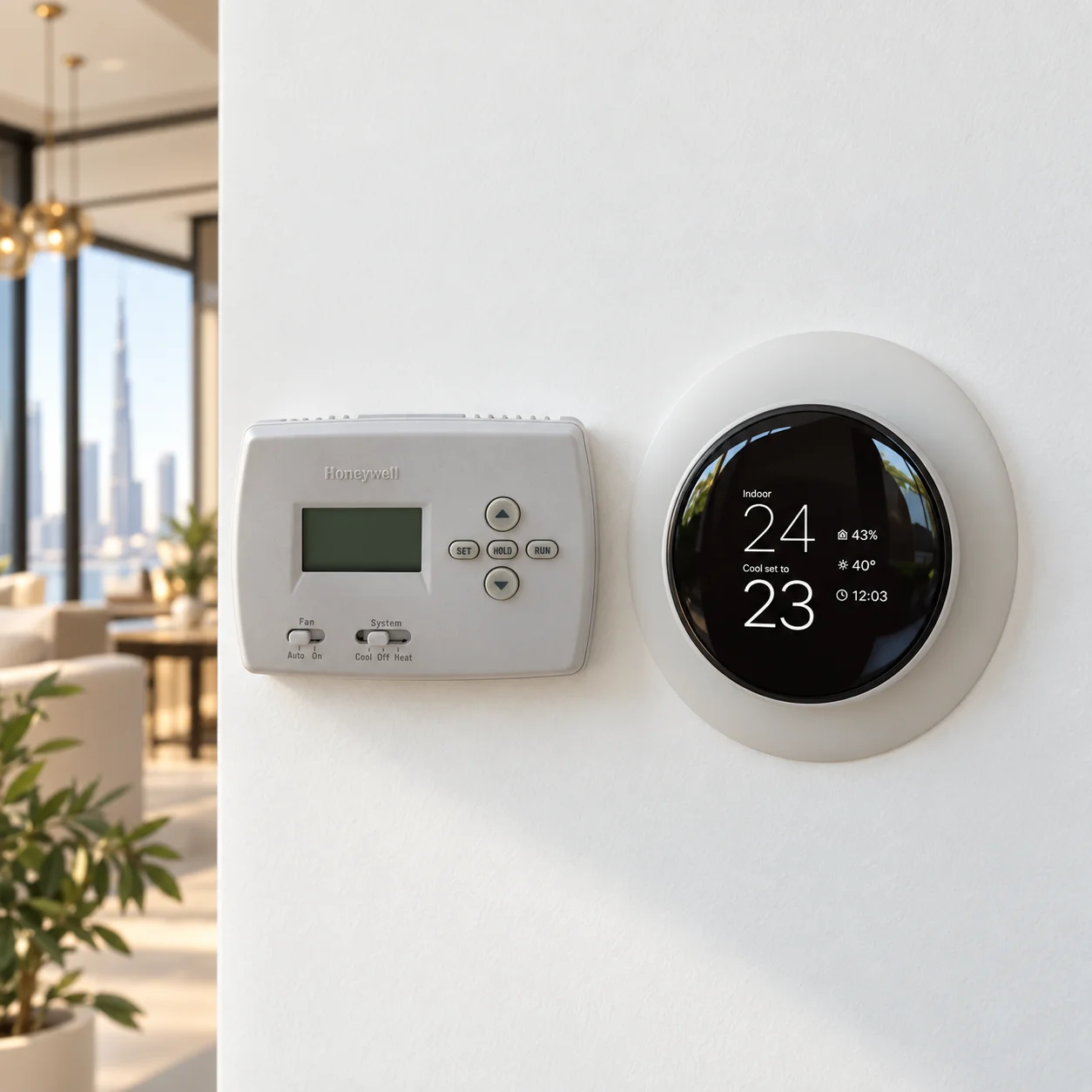
Yes, but the Honeywell Brand Alone Does Not Decide Compatibility
A Honeywell thermostat can often be replaced with a Google Nest, but the important question is what the thermostat is controlling. Your AC system's voltage, wiring, fan control and communication method determine whether the upgrade is straightforward or needs additional hardware.
For UAE homes: a compatible 24V HVAC control system may support Nest directly. A 220–240V fan-coil controller, multi-speed FCU, proprietary controller or communicating inverter AC may require a converter, relay interface or dedicated HVAC adapter.
Is a Nest Thermostat Compatible With Your Honeywell Setup?
Two Honeywell thermostats can look similar on the wall yet control completely different AC systems. The system behind the thermostat is what determines the right replacement route.
Do Not Judge Compatibility by the Honeywell Model Name Alone
One Honeywell thermostat may use conventional low-voltage terminals such as R, Y, G and C. Another may control a fan-coil unit using higher voltage. A third may communicate with the AC through a proprietary controller.
That is why Honeywell thermostat Nest compatibility needs to be checked at system level. The safest sequence is to identify the control type, confirm the voltage and connected terminal labels, then decide whether Nest can be wired directly or needs additional hardware.
Conventional 24V Control
If the existing Honeywell uses compatible low-voltage HVAC terminals and the system can supply the power required by the selected Nest model, replacement may be relatively direct.
No Connected C-Wire
A missing C-wire does not automatically mean Nest is incompatible. Some installations can operate without one, while others need a C-wire or suitable power accessory.
220–240V or FCU Control
Nest should not be connected directly to high-voltage thermostat wiring. A suitable low-voltage conversion and control interface may be required.
Proprietary or Inverter Control
Some AC systems communicate digitally with their original controller. Those systems may require a dedicated compatible adapter instead of conventional Nest wiring.

Honeywell-to-Nest Compatibility Matrix
| Existing system | Likely Nest route | What needs checking |
|---|---|---|
| Compatible 24V HVAC control | Often direct | Terminal labels, HVAC equipment type, available power and compatibility with the exact Nest model. |
| 24V system without C-wire | Check power | Whether the selected Nest and HVAC system require a C-wire or compatible power accessory. |
| 220–240V Honeywell FCU thermostat | Conversion likely | Supply voltage, valve control, fan speeds and suitable isolation or conversion hardware. |
| Three-speed fan-coil unit | Model dependent | Low, medium and high fan outputs, valve logic and available thermostat/interface support. |
| Proprietary controller | Adapter / interface | Communication protocol, non-standard terminals and compatible integration hardware. |
| Inverter / communicating AC | Interface required | AC brand, model, communication protocol and suitable adapter. |
Safety point: if the existing thermostat or wiring is marked 120V, 220V, 230V or 240V, do not connect those wires directly to a Nest thermostat. The control system should be assessed first.
24V vs 220–240V: The Most Important Check Before Replacing Honeywell With Nest
Many compatibility problems begin when every wall thermostat is treated as though it uses the same voltage and control method.
When a 24V Honeywell System May Be a Good Nest Candidate
Google Nest thermostats are primarily designed around compatible low-voltage HVAC control systems. If the existing Honeywell thermostat uses conventional 24V control terminals, the Honeywell-to-Nest replacement is usually simpler than replacing a mains-voltage FCU controller.
Common terminal labels can include R or Rc/Rh for power, Y for cooling, G for fan and C for common power. Heat-pump and multi-stage systems may use additional terminals.
Important: use the terminal labels and HVAC configuration when checking compatibility. Do not assume a wire's function only from its colour.
Why a 220–240V Honeywell Thermostat Is Not a Direct Nest Swap
Some Honeywell thermostats used with fan-coil units control higher-voltage circuits. Nest should not be connected directly to those wires.
A suitable installation may need a step-down transformer, relays, an FCU interface or another purpose-built conversion system that gives Nest safe low-voltage control while preserving the required AC functions.
This is particularly relevant in UAE apartments and villas using fan-coil or chilled-water cooling. A Nest thermostat fitting physically on the wall does not mean the electrical controls behind it are compatible.

Does Nest Need a C-Wire When Replacing a Honeywell Thermostat?
Not always. A C-wire provides continuous power to the thermostat, but whether it is required depends on the Nest model and the HVAC system.
Some installations can work without a connected C-wire. Other systems may require one or an approved power accessory to provide stable thermostat power.
Useful rule: treat the C-wire as part of the power assessment, not as a simple yes-or-no test for Nest compatibility.
Why Honeywell-to-Nest Replacement Can Be Different in UAE Homes
Many international Nest guides assume a conventional HVAC system. UAE properties may use fan-coil units, chilled-water cooling, multi-speed fans or communicating inverter AC systems.
FCU and Multi-Speed Fan Compatibility
A fan-coil unit may use separate controls for the cooling valve and multiple fan speeds. That makes the job more involved than a simple cooling on/off signal.
Before replacing a Honeywell FCU thermostat with Nest, the installer should determine the thermostat voltage, number of fan speeds, valve control and whether the selected Nest/interface can reproduce the functions required by that particular FCU.
Some Nest configurations can support multiple fan-speed connections, but that does not mean every UAE FCU is directly compatible. The complete control system still needs to be checked.

When Nest Needs an HVAC Adapter Instead of Conventional Wiring
Some inverter and communicating AC systems do not provide the conventional thermostat terminals that Nest expects. Instead, the indoor unit and original controller communicate using a brand-specific protocol.
In suitable systems, an HVAC interface can translate the thermostat request into commands the AC understands. JustCare uses system-specific solutions where appropriate, including DropAir adapters for compatible HVAC systems .
The adapter should be selected using the AC brand, model and control protocol. A DropAir or similar interface should not be treated as a universal adapter for every AC.

When a 24V Thermostat Conversion Kit Is the Right Route
Where the existing control system can safely be converted to conventional low-voltage thermostat logic, a 24V thermostat conversion kit may form part of the solution.
The purpose is not simply to reduce voltage. The complete installation must also provide the correct cooling, fan and valve behavior required by the original AC system.
A transformer alone is not automatically a compatibility solution. The control logic and outputs also have to match the HVAC system.
Real Honeywell-to-Nest Replacement in Jumeirah Park, Dubai
A completed JustCare installation in District 9 demonstrates why a Honeywell-to-Nest upgrade should begin with compatibility rather than simply swapping the wall thermostat.
District 9, Jumeirah Park
- Existing controller: Honeywell thermostat
- Upgrade: Nest Learning Thermostat 3rd Gen
- Installation route: converter-based integration
- Existing AC unit remained in place
- Nest setup and AC testing completed
In this installation, the existing Honeywell thermostat was not treated as a simple like-for-like replacement. The AC control requirements were reviewed first, then the Nest thermostat was integrated using the required converter hardware.
That real-world example explains why the answer to "Can I replace my Honeywell thermostat with Nest?" can be yes even when the wiring is not directly compatible. The installation method depends on the AC system behind the thermostat.
A compatibility assessment also helps avoid buying a thermostat first and discovering later that additional controls, wiring or an HVAC adapter are required.


How to Check Your Honeywell Thermostat Before Buying Nest
A few clear photos and system details can usually provide much more useful information than guessing from the thermostat's appearance.
Identify Honeywell
Take a clear photograph and note the exact Honeywell thermostat model number.
Check Terminals
Where safely accessible, photograph the terminal labels and which terminals are connected.
Identify the AC
Record the indoor-unit brand/model and whether the system is an FCU, ducted, split or inverter AC.
Choose the Route
Select the Nest model and any required converter or adapter only after compatibility is understood.
What JustCare Needs for a Honeywell-to-Nest Compatibility Check
Do not remove unfamiliar high-voltage wiring just to take a photograph. If you see 220–240V markings or are unsure about the wiring, leave the thermostat in place and arrange a professional check.
Do Not Match Nest Wiring by Colour Alone
Thermostat wire colours are not a universal guarantee of function. For example, a red wire should not automatically be treated as R unless it is actually connected to the R terminal.
Compatibility should be based on terminal labels, equipment type, voltage and the existing HVAC control arrangement.
Which Google Nest Thermostat Should Replace Honeywell?
Choose the thermostat after the AC system is identified. A newer Nest model does not automatically solve a voltage, wiring or communication mismatch.
Nest 3rd Gen vs Nest 4th Gen: Start With Compatibility
Both Nest generations are designed for compatible HVAC systems, but terminal support, system requirements and installation options are not identical.
If you are considering the Nest Learning Thermostat 4th Generation , confirm the actual AC control system first rather than choosing it only because it is the newer model.
Nest 3rd Gen also remains relevant in existing installations, including JustCare's Honeywell-to-Nest conversion in Jumeirah Park.
Direct Wiring, Conversion Kit or HVAC Adapter?
Direct Compatible Wiring
Used when the existing system is confirmed as compatible low-voltage HVAC control with suitable Nest terminals and reliable power.
24V Conversion
Used where the original Honeywell control needs a suitable conversion/interface before Nest can safely operate the AC.
Inverter / Protocol Adapter
Used for compatible communicating AC systems requiring an interface between Nest and the manufacturer's control protocol.
Keep the Existing Controller
If critical AC functions cannot be reproduced reliably, the technically correct recommendation may be not to install Nest on that system.
What a Proper Honeywell-to-Nest Replacement Should Include
Professional thermostat replacement is more than attaching the new thermostat to the wall. The system should be assessed, powered down safely, connected using the correct installation route and tested after setup.
JustCare provides professional smart thermostat installation for compatible Nest, Ecobee and other smart thermostat systems, including wiring and conversion solutions where required.
How Much Does It Cost to Replace a Honeywell Thermostat With Nest?
The final cost depends on the AC control system rather than the Honeywell thermostat alone. A straightforward compatible installation costs less than an FCU conversion or inverter integration that requires extra hardware.
Wiring requirements, converter kits, HVAC adapters and the Nest model can all affect the total. For an accurate quote, send JustCare the thermostat photos and AC model before booking.
Best approach: confirm compatibility first, then quote the thermostat, installation and any required converter/interface separately.
Honeywell-to-Nest Compatibility FAQs
Straightforward answers to common questions UAE homeowners ask before replacing a Honeywell thermostat with Google Nest.
Can I replace any Honeywell thermostat with a Nest?
No. Many Honeywell thermostats can be replaced with Nest, but compatibility depends on the HVAC system, voltage, terminal wiring, fan control and communication method.
Is Nest compatible with a Honeywell T6861 thermostat?
A Honeywell T6861-type fan-coil installation should be assessed as an HVAC system rather than treated as a direct thermostat swap. Depending on the wiring and FCU controls, a suitable low-voltage interface or conversion solution may be required.
Can Nest replace a 220V or 240V Honeywell thermostat?
Nest should not be connected directly to high-voltage thermostat wiring. Some systems can be made compatible using properly designed conversion and control hardware installed by a professional.
Do I need a C-wire to replace Honeywell with Nest?
Not in every installation. Some Nest configurations can operate without a connected C-wire, while other systems need one or a compatible power accessory. The requirement depends on the Nest model and HVAC system.
Can Nest work with an FCU in a Dubai apartment?
It may be possible, but the FCU should be assessed first. Thermostat voltage, fan speeds, valve control and overall wiring determine whether Nest can be integrated directly or through an interface.
Can Nest control a three-speed fan?
Some Nest Learning Thermostat configurations can support multiple fan-speed connections, but this does not make every three-speed FCU compatible. The exact system, wiring and interface still need to match.
Do I need a converter or DropAir adapter for Nest in the UAE?
Only when the AC system requires one. A conversion kit can provide suitable low-voltage thermostat control for certain systems, while a compatible HVAC adapter may be required for specific inverter or communicating AC systems.
How do I know whether my Honeywell thermostat is 24V?
Check the thermostat documentation, terminal arrangement and HVAC system information rather than guessing from the wire colours. If the thermostat is marked with mains voltage such as 220–240V, do not attempt a direct Nest connection.
Can I install Nest myself after removing my Honeywell thermostat?
Only if the HVAC system has been positively identified as compatible and you can safely follow the exact instructions for your Nest model. High-voltage, FCU, proprietary and communicating systems should be professionally assessed.
What should I send JustCare for a Nest compatibility check?
Send a clear photograph of the existing Honeywell thermostat, its model number, a readable photo of connected terminal labels where safely accessible, and the indoor AC unit's brand and model. Also mention whether the AC has multiple fan speeds and your UAE location.
Want to Upgrade Your Honeywell Thermostat to Google Nest?
Send JustCare your Honeywell thermostat model, wiring photos and AC model before buying or installing anything. We can identify whether the likely installation route is direct wiring, a 24V conversion or a compatible HVAC adapter.